

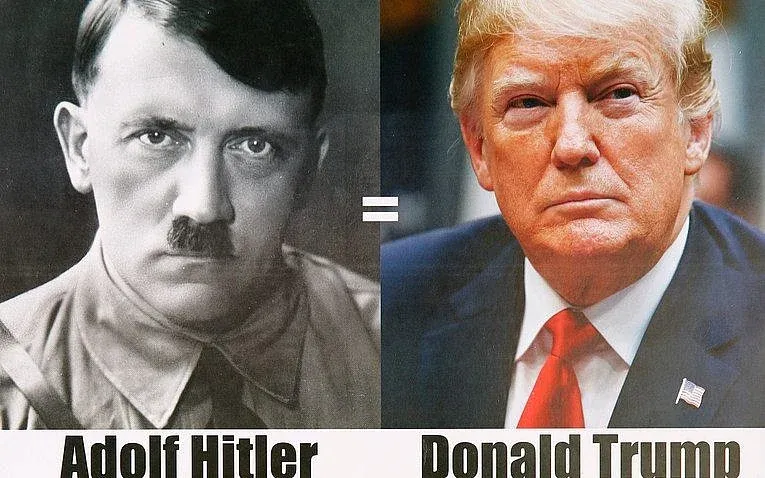
Trump’s Hitler Comparison Returns: Donald Trump has never shied away from controversy. Whether through campaign rallies, social media posts, or interactions with world leaders, the US President has built a political identity around grabbing attention and dominating headlines.
That reputation was on display once again after Trump shared a document on Truth Social that compared his global influence to some of history’s most powerful and feared rulers, including Adolf Hitler, Genghis Khan, Mao Zedong, Joseph Stalin, and Alexander the Great.
The post quickly sparked debate, not only because of the controversial comparisons but also because of the individual who authored the document. As details emerged, it became clear that the so-called “presidential historian” behind the assessment was not actually a historian at all.
Adding to the intrigue, a new book set for release next week offers fresh insight into how Trump first encountered the document and why he appears to value it so highly.
Trump Shares Controversial Historical Comparison
On Thursday, Trump posted a two-page assessment on his social media platform, Truth Social, accompanied by the caption:
“Presidential Historian Dave King – Sounds good to me!”
The document argued that Trump’s global influence exceeds that of several historical figures often remembered for conquest, military power, or authoritarian rule.
According to the assessment, while rulers such as Hitler, Stalin, Genghis Khan, and Attila the Hun wielded enormous power during their lifetimes, their influence remained geographically limited when compared to the reach of a modern American president.
The document claimed that Trump possesses a level of global influence unmatched by historical leaders because of modern technology, international markets, global media, and America’s economic power.
Trump’s Hitler Comparison Returns : The comparison immediately attracted attention due to the inclusion of controversial figures such as Hitler and Stalin alongside Trump’s name.
New Book Reveals Where the Document Came From
The story behind the document is explored in a new book titled Regime Change, written by New York Times journalists Maggie Haberman and Jonathan Swan.
According to excerpts from the book, Trump first discussed the document during an interview with the authors in March.
When asked about his place in history and the power he exercises during his second presidential term, Trump reportedly presented the document as evidence of his unique influence on world affairs.
Trump explained that he had received the assessment during an event honouring legendary golfer Gary Player.
At the time, the document appeared to come from someone Trump described as a presidential historian, giving it an air of authority.
However, the journalists decided to investigate further.
The ‘Historian’ Was Not a Historian
The most surprising revelation from the book concerns the identity of Dave King, the man credited as the document’s author.
After conducting their research, the journalists discovered that King is not a historian, academic, or university scholar.
Instead, Dave King is a businessman originally from Scotland who later settled in South Africa. He is also known for his long association with golfing legend Gary Player, serving as a close aide and longtime caddie.
Some readers may even confuse him with historian David King, a respected author and Harvard-educated scholar, but the two men are entirely different individuals.
Reports suggest that King has no formal academic background in history and has never worked professionally as a historian.
Nevertheless, his assessment found its way into Trump’s hands.
According to accounts detailed in the book, King first shared his views with Gary Player before eventually discussing them with Trump during a golf outing.
What Did the Document Actually Say?
The document attempts to compare Trump’s influence with some of history’s most powerful leaders.
Historical Figures Mentioned in the Assessment
| Historical Figure | Basis of Comparison |
|---|---|
| Alexander the Great | Military conquest and empire-building |
| Genghis Khan | Expansion of territory and influence |
| Attila the Hun | Fear and military dominance |
| Adolf Hitler | Political control and wartime power |
| Joseph Stalin | State authority and influence |
| Mao Zedong | National transformation and political reach |
| Donald Trump | Modern global influence through technology and economics |
The central argument presented by King is that modern communication systems, financial markets, and global interconnectedness allow a US president to influence events worldwide in ways historical rulers could not.
The document states that many historical leaders ruled through fear and conquest, whereas Trump’s influence extends across international politics, economics, trade, and media.
The Reference to Trump’s Tariff Policies
The assessment also praises Trump’s use of economic tools, particularly tariffs, as an example of modern presidential power.
It argues that decisions made in Washington can instantly affect markets, industries, and governments across the world.
However, critics point out that several of Trump’s tariff initiatives have faced legal challenges, with courts scrutinising aspects of his trade policies.
The broader debate surrounding tariffs continues to divide economists and policymakers.
Trump’s Long History of Controversial Comparisons
The Hitler comparison is particularly notable because it recalls comments made years before Trump’s return to the White House.
In 2016, before becoming vice president, JD Vance famously referred to Trump as “America’s Hitler” during a period when he was critical of Trump’s political rise.
Although Vance later became one of Trump’s strongest allies, the remark remains one of the most widely discussed comments from Trump’s early political career.
As a result, any comparison involving Hitler inevitably generates significant public attention.
Inside ‘Regime Change’
Beyond the document itself, Regime Change promises to provide a detailed look at Trump’s second term and his governing style.
The book reportedly explores several major developments, including:
| Topics Covered in the Book |
|---|
| Trump’s foreign policy decisions |
| His approach to international conflicts |
| Internal White House operations |
| Economic and trade policies |
| Personal habits and routines |
| Oval Office redesign choices |
| Late-night eating habits |
| Private lifestyle details |
According to early reports, the book paints a picture of a president exercising power with fewer restraints while continuing to embrace unconventional decision-making and headline-grabbing tactics.
Why the Story Matters
The controversy surrounding the document is not simply about historical comparisons. It raises broader questions about the sources political leaders rely on, the role of personal validation in politics, and how narratives about power and legacy are constructed.
For supporters, the document reinforces the idea that Trump is one of the most influential political figures of the modern era.
For critics, the episode highlights the tendency to elevate personal opinions into historical judgments without expert scrutiny.
Either way, the story has once again placed Trump at the centre of a global conversation — something he has managed to do consistently throughout his political career.
Trump’s Hitler Comparison Returns: With Regime Change set to hit bookshelves soon, the debate surrounding Trump’s legacy, influence, and leadership style is unlikely to fade anytime soon.