


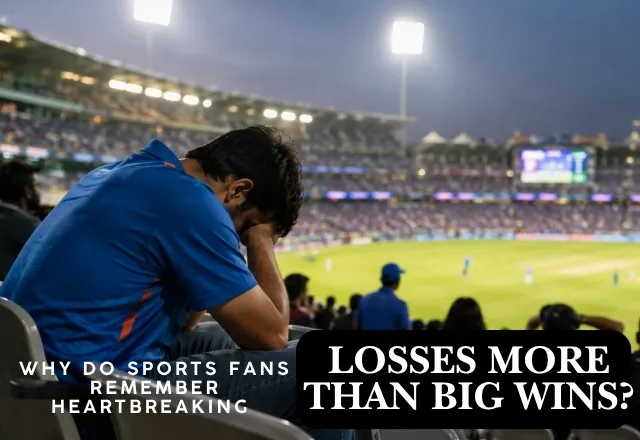
Ask any sports fan about a match they will never forget, and it is likely they will not mention a trophy. They will mention the final their team almost won. The last-minute goal. The match that slipped away when victory felt certain.
Years later, they will remember exactly where they were standing, who they watched it with, and how their stomach dropped when it ended. Some fans still talk about these moments like they happened last week.
So why does a painful loss stay longer than a win ever does?
It turns out being a fan was never really about watching a game. It is tied up with emotion, memory, expectation, and this strange sense of connection we build with teams we will never actually meet.
Why Does It Feel Personal?
Technically, it is a game. Twenty-two people on a field, two teams chasing a result.. For fans, it rarely feels that simple.
Imagine watching a cricket match with your family. Everyone leans in when the team starts well. Every boundary gets a cheer; every wicket tightens the room. By the overs, one small moment can flip the entire mood of the house.
Now imagine your team losing from a winning position. That disappointment does not feel small. It can feel personal, even frustrating, even though you never set foot on the field.
That is because a lot of fans genuinely feel connected to their team. They follow the players, argue about performances, show up for every match share the highs with supporters. Over time, it stops being a hobby and starts being part of who they’re. So when the team loses, something in you loses too.
Why Do the Losses Stay Longer?
Part of it comes down to how our brains handle moments in general.
Think about your life for a second. You probably cannot remember a Tuesday at work from three years ago. An embarrassing mistake, a disappointing result? That stays with you. Sports work the same way.
A heartbreaking loss usually comes with an emotional hit. The team needed one run. The penalty got missed. The goal went in during stoppage time. These moments are sudden, intense, and hard to shake off.
Then there is the replaying. Fans go back over it again. Again. What if that player had made a different call what if the referee had seen it differently. Those unanswered “what ifs” are exactly what keeps a memory alive.
Research into sports fandom has actually looked at this. How a loss can threaten a fan’s sense of connection to their team and genuinely affect their mood afterward. It is not identical for everyone. It explains why some defeats feel so much bigger than the scoreline ever suggests.
It Is Really About the Hope That Came Before It
Here is the other piece. A loss hurts in proportion to how you let yourself believe beforehand.
When a team has been playing well all tournament, fans start imagining the celebration. They are already picturing the trophy lift, already telling themselves this might finally be the year.
The more confident you get, the harder the fall when it does not happen.
Say a cricket team needs a handful of runs with wickets still in hand. Fans are already mentally celebrating. If that team somehow loses from there, it stings more than losing a match that was never close to begin with.
It is not really about losing. It is about losing something that for a moment felt like it already belonged to you.
That is what makes certain sporting moments so hard to let go of.
So Why Do We Keep Coming
This might be the interesting part of all.
If supporting a team brings this heartbreak, why do fans show up for the next match anyway? Why keep buying the jersey, keep checking the score, keep caring after a season?
Because sports were never only about winning.
For a lot of people, watching a match is really about who you’re watching it with. It builds conversations, traditions, memories that have nothing to do with the result. Some fans remember watching games with a parent as a kid. Others tie a team to their hometown or to a player they idolized growing up.
There is always next time.
A team that loses today might come back brilliant next season. A player who fumbles the moment today might be the hero tomorrow. That possibility is what keeps people hanging on.
In a way, the pain of losing is exactly what makes the eventual win feel so much bigger. When a team finally breaks through after years of disappointment, the celebration carries every bit of that history with it.
Social Media Makes It Harder to Let Go
Fans used to process a loss over dinner with family or venting to a coworker the next day. Now? Social media turns it into something louder.
Within minutes of a defeat there are reaction videos, memes, hot takes, player interviews, and an avalanche of comments. Even if you genuinely want to move on, the match keeps finding you.
That can stretch out the disappointment. Watching the missed chance on a loop, reading argument after argument about who’s to blame. It cuts both ways too. Social media also connects you with people who feel the same way, and sometimes joking about a bad result with strangers online makes it easier to actually shake off.
Worth remembering, though: it is still a game. Caring is fine. Letting one result control your mood for days is not really the point.
What Sports Losses Can Teach Us
Enough the way fans handle defeat says something about life outside of sports too.
Disappointment is just part of caring about anything. Work, studies, personal goals, whatever it is. The things that matter to us are the things capable of letting us down.
A loss is a reminder that effort does not guarantee an outcome. It is also a lesson in patience, perspective and giving things another shot.
For athletes, a loss becomes something to study and fix. For fans, it is a reminder that loving sports was always about the journey, not just the final scoreboard.
Not that every match needs to turn into some life lesson. Sometimes you are just allowed to be annoyed, complain for a bit, and move on.
The Bottom Line
Sports have this power to bring people together and just as easily to break their hearts a little.
A win gives you one night to celebrate. A painful loss can leave you replaying it for years. Strong emotion, personal identity, sky-high expectations, endless online discussion. All of it adds up to explain why some defeats just refuse to fade.
Maybe that is the whole point. If none of it mattered, losing would not hurt this much in the place.
So when your team breaks your heart, let yourself feel it. Talk about it if you need to. Then look ahead to the next match.
Because, for a fan, one bad result is never really the end of the story.
Sometimes the losses are exactly the ones we end up remembering the longest.