


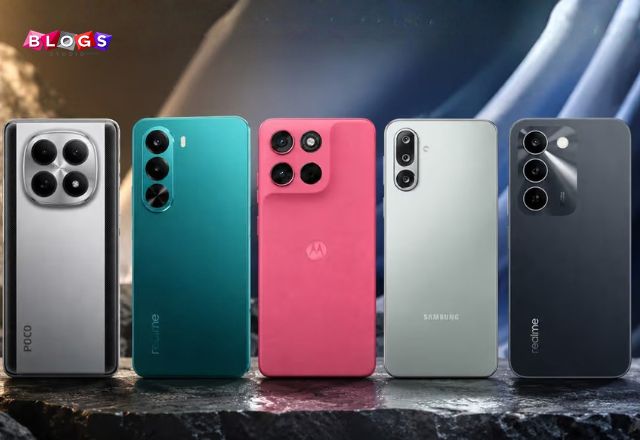
Let’s talk honestly about buying a phone under ₹30,000 this year — it’s just not as simple as it used to be. A RAM shortage has been pushing prices around all through 2026, and a few phones on this list have jumped by thousands of rupees in weeks, not months. So take the prices below as a snapshot from late September 2026, and please check them again before you hit publish, or before you buy.
Quick Comparison
| Phone | Approx. Price | Display | Processor | Battery | Best For |
| Motorola Edge 70 Fusion | ₹26,999–29,999 | 6.78″ AMOLED, 144Hz | Snapdragon 7s Gen 4 | 7,000mAh, 68W | All-round use |
| Poco X8 | ₹29,999 | 6.83″ 1.5K AMOLED, 120Hz | Snapdragon 6s Gen 5 | 9,000mAh, 67W | Display & battery |
| Redmi Note 17 5G | ₹27,999 | 6.99″ AMOLED, 120Hz | Snapdragon 4 Gen 4 | 8,000mAh, 45W | Long-term updates |
| OnePlus Nord CE 6 Lite | ₹20,999–28,999 | 6.72″ LCD, 144Hz | Dimensity 7400 Apex | 7,000mAh, 45W | Value/budget |
| Samsung Galaxy F70 Pro | ₹23,999–25,999 | 6.7″ AMOLED, 120Hz | Snapdragon 6 Gen 3 | 6,000mAh, 45W | Samsung users |
1. Motorola Edge 70 Fusion
This is the one to pick if you just want a phone that gets everything mostly right without making you think too hard. It runs a 144Hz AMOLED display and a 7,000mAh battery with 68W charging, powered by Motorola’s Snapdragon 7s Gen 4 chip, and the camera setup is led by a 50MP main sensor.
What’s good: it charges faster than everything else on this list, the screen looks great, and it’s built to survive a splash or two (IP68/69 rated). What’s not so good: honestly, nothing jumps out as a weak point — which is sort of the point of this phone. It’s not the cheapest here, though, so if budget is tight, look further down.
2. Poco X8
If you care about how the phone actually feels in your hand day to day, this one’s worth a serious look. It’s got a sharp 120Hz AMOLED panel and up to 8GB RAM, paired with a 9,000mAh battery — the biggest on this list by a decent margin — and Poco is promising four years of OS updates plus six years of security patches.
The trade-off is the software. HyperOS tends to feel a bit crowded with pre-installed stuff, and video recording caps out at 1080p on the base model, which might annoy anyone who films a lot of casual video. Still, for pure battery life and screen quality, it’s hard to beat at this price.
3. Redmi Note 17 5G
This is the phone for someone who’s tired of babysitting their charger. It packs a genuinely massive 8,000mAh battery — the biggest a Redmi Note has ever had — with a 120Hz AMOLED display and a promise of four years of OS updates, six years of security patches.
The catch: charging is slower than the others here at 45W, and the cameras are more “good enough” than exciting. If you mostly want your phone to last all day without worrying, this earns its spot. If photography matters more to you, keep reading.
4. OnePlus Nord CE 6 Lite
This used to be the easy budget pick. It launched with a 144Hz display and a 7,000mAh battery on the Dimensity 7400 Apex chip, and at its original price, it genuinely was a great deal.
Here’s the thing worth flagging honestly: this phone’s price has climbed a lot since launch — over ₹2,000 in a single recent month, according to price-tracking data — so whether it’s still the “value pick” really depends on the day you check. It also uses an LCD screen rather than AMOLED, which shows in how blacks and colors look compared to the other phones here.
5. Samsung Galaxy F70 Pro
If you’d rather stick with a brand you already trust, or you just want software support that outlasts the phone itself, this is the one. It runs on the Snapdragon 6 Gen 3 chip with a 6,000mAh battery, and Samsung is backing it with six years of both OS and security updates — a genuinely rare commitment at this price point.
It’s also the cheapest phone on this list. The trade-off is battery capacity, which is noticeably smaller than the rest, and low-light camera performance that reviewers found a bit underwhelming.
How to Choose
- Want raw performance? The Poco X8 and Motorola Edge 70 Fusion lead here.
- Care about the display? Skip the Nord CE 6 Lite if AMOLED matters to you — it’s the only LCD phone on this list.
- Chasing battery life? Go Poco X8 or Redmi Note 17.
- Want your phone to age well? Poco X8 and Galaxy F70 Pro both commit to six years of security updates.
- Need fast charging? Motorola’s 68W wins easily.
FAQ
So which phone should I actually buy?
Honestly, there’s no single “best” here — it comes down to what you personally care about. Want the biggest battery? Poco X8. Want software support that lasts years? Galaxy F70 Pro. Want fast charging and a phone that just works? Motorola Edge 70 Fusion.
Do all of these support 5G in India?
Yes, every phone on this list is 5G-ready with Indian band support.
Will these prices still be accurate when I read this?
Maybe not — that’s the honest answer. A few of these have moved by thousands of rupees in just weeks because of the ongoing RAM shortage. Always check the current listing before you buy.
One more thing worth fixing before you publish: your Poco X8 link currently points to a “Poco X8 Pro” product page, which is a different, pricier phone. Swap that link so readers don’t land on mismatched specs.