

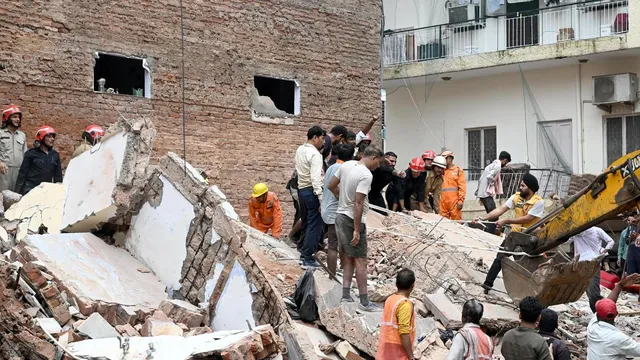
A routine Sunday afternoon in Delhi’s Satya Niketan turned into a major rescue operation on September 6, 2026, after a five-storey building being used as a paying guest accommodation collapsed suddenly.
The building, located in the busy student neighbourhood near Delhi University’s South Campus, came down in a matter of seconds. Several people were trapped under the debris, prompting an immediate rescue effort by local residents, police and emergency services.
What began with neighbours and students trying to pull people out of the rubble soon turned into a coordinated operation involving the Delhi Police, Delhi Fire Service and the National Disaster Response Force.
By the following morning, officials had confirmed that six people had died. Several others were rescued and taken to hospitals for treatment.
The investigation is now focused on why the building collapsed and whether renovation or excavation work carried out shortly before the incident contributed to the disaster.
What Happened in Satya Niketan on September 6?
The building collapsed at around 1:30 pm to 1:34 pm on Sunday in Satya Niketan, a densely populated area of southwest Delhi that is known for its large student population and numerous PG accommodations.
According to preliminary reports, the building was around five storeys high and had been in use as a boys’ paying guest accommodation.
The structure was also reportedly undergoing renovation work at the time of the collapse. Basement excavation was among the work being carried out, making the construction activity an important part of the investigation.
Residents in the area described hearing a loud sound before the building suddenly gave way. A large cloud of dust covered the area as sections of the structure collapsed onto themselves.
The incident caused panic among people living and working nearby. Students, residents and shopkeepers rushed towards the site in an attempt to find anyone who might have survived.
Local Residents Were First to Reach the Debris
Before specialised rescue teams arrived, people from the surrounding area began helping at the site.
Neighbours and students reportedly formed groups to move smaller pieces of debris and search for people trapped underneath. Their immediate response helped rescuers identify possible locations where victims could be trapped.
The situation was difficult because large sections of the building had collapsed together. Moving the rubble too quickly could have created additional risks for anyone who might still have been alive underneath.
Emergency teams therefore had to balance speed with caution throughout the operation.
Rescue Teams Continue Search Through the Night
The rescue operation expanded as Delhi Fire Service personnel, police teams and NDRF personnel reached the location.
Heavy equipment was brought in to remove larger sections of the collapsed structure. Rescue workers also searched through smaller sections manually when they believed someone could be trapped underneath.
The operation continued into the night and into the following morning.
Officials had to work carefully because the remaining debris could shift during the removal process. Rescue workers also faced the challenge of reaching deeper sections of the collapsed building without putting trapped survivors or rescue personnel at further risk.
Six People Confirmed Dead in the Building Collapse
The death toll increased as rescue workers continued searching the debris.
Initial reports on Sunday indicated that one person had died. The number later increased to three as more victims were recovered.
By early Monday, officials had confirmed six deaths following the recovery of another body during overnight operations.
Several other people were rescued alive from the site. Reports put the number of people rescued at roughly 10 to 13, although figures may vary as authorities continued to verify the identities and condition of those involved.
Those who were injured were taken to hospitals, including the AIIMS Trauma Centre, for medical treatment.
The final number of people affected by the collapse will depend on the completion of the rescue operation and official verification.
What Caused the Satya Niketan Building to Collapse?
The exact cause of the collapse has not yet been established by the investigation.
However, preliminary reports have focused attention on renovation and excavation work being carried out at the property.
One possibility being examined is that excavation in the basement may have affected the stability of a load-bearing pillar. If a critical structural support was shifted or weakened, it could have affected the stability of the floors above it.
Delhi Chief Minister Rekha Gupta has reportedly referred to the shifting of a pillar as a possible trigger for the collapse.
That theory, however, should not be treated as the final finding. A formal investigation will be required to determine whether the renovation work directly caused the structural failure.
Investigators are also expected to examine the building’s age, construction quality, structural condition and any alterations made over the years.
Was Basement Excavation Linked to the Collapse?
Basement excavation is one of the key issues being examined by authorities.
Excavation near or underneath an existing building can affect its foundations if it is not carried out with appropriate engineering precautions. The risk can become greater when an older structure has already undergone modifications or when its original structural design is unclear.
In the Satya Niketan case, investigators are looking into whether excavation or other renovation activity changed the load distribution of the building.
Officials are also examining whether the work was being carried out with the required permissions and whether proper safety measures were followed.
Until the investigation is completed, it would be premature to identify excavation as the confirmed cause.
Police File FIR Against Building Owner and Others
Delhi Police have registered an FIR in connection with the collapse.
The building’s owner, identified in reports as Hariram, along with other people, has been named in the case.
The FIR reportedly includes provisions of the Bharatiya Nyaya Sanhita relating to culpable homicide not amounting to murder, negligent construction or repair of a building and actions that endanger the safety of others.
Police teams have been formed to investigate the circumstances surrounding the collapse and trace people named in the case.
Investigators are expected to examine who authorised the renovation work, what work was being carried out immediately before the collapse and whether any safety requirements were ignored.
Building Declared Unsafe and Demolition Ordered
Following the collapse, the Municipal Corporation of Delhi declared the affected structure unsafe and ordered its demolition.
Authorities also reportedly evacuated nearby structures as a precaution.
The decision is aimed at preventing another incident in case parts of the remaining structure are unstable.
Buildings located close to a collapsed structure can face additional risks if the foundations, walls or adjoining sections have been affected.
Officials therefore have to assess surrounding properties before allowing residents to return.
Magisterial Inquiry Ordered Into the Incident
A magisterial inquiry has also been ordered to establish what led to the building collapse.
The inquiry is expected to examine the construction history of the property, renovation work, permissions and structural safety issues.
It may also look into whether the building had received the necessary approvals and whether officials or property owners had been alerted about any safety concerns.
The investigation will be important in determining responsibility rather than relying only on preliminary theories about what happened.
Delhi Government Promises Action Against Those Responsible
Delhi Chief Minister Rekha Gupta said the immediate priority was to rescue people who could still be trapped under the debris.
The government has also indicated that responsibility will be fixed if negligence is established.
According to reports, the Chief Minister spoke with Union Home Minister Amit Shah and Union Health Minister JP Nadda regarding the incident. Central assistance and medical support were also discussed as rescue and treatment efforts continued.
The focus for authorities remains divided between completing the rescue operation, providing medical treatment to survivors and determining how the building was allowed to reach a condition where such a collapse could occur.
Why Old PG Buildings in Delhi Face Safety Concerns
The Satya Niketan incident has once again raised questions about the safety of older buildings being used as PG accommodations.
Areas around Delhi University’s campuses have thousands of students living in rented rooms, hostels and paying guest properties. Many buildings were originally constructed for different purposes and have since been modified to accommodate more residents.
Renovation can sometimes involve changes to walls, floors, foundations or other structural elements.
When such work is carried out without proper structural assessment, it can create serious risks.
The age of a building alone does not mean that it is unsafe. However, older structures need appropriate inspections, especially when major renovation or excavation work is planned.
Unauthorised Construction and Structural Changes Under Scrutiny
Another issue frequently associated with building safety in densely populated parts of Delhi is unauthorised construction.
Buildings can change significantly over time. Additional rooms may be constructed, walls may be removed, floors may be altered and spaces originally intended for one purpose may be converted into residential accommodation.
Each structural change can affect how a building distributes its weight.
This is why authorities are expected to examine not only the original construction but also modifications carried out later.
In the Satya Niketan case, investigators will have to determine whether any such changes played a role in the collapse.
What Students Should Check Before Moving Into a PG
The incident is also a reminder for students and families to pay attention to basic safety conditions before renting a PG.
The age of the building is one factor, but it should not be the only consideration.
Students can ask whether the property has undergone recent structural changes or major renovation. They should also be cautious if significant construction or excavation is taking place while residents are still living inside the building.
Visible cracks, unusual tilting, damaged structural elements or repeated water-related problems should not simply be ignored.
Where possible, residents should also know the emergency exits and evacuation routes of the building.
These precautions cannot guarantee that an accident will never happen, but they can help residents identify obvious warning signs and respond more quickly during an emergency.
What Happens Next in the Satya Niketan Case?
The immediate priority is to complete the search and rescue operation and ensure that officials are certain no one remains trapped under the debris.
After that, investigators will have to reconstruct what happened before the collapse.
That investigation is likely to include the building’s original construction records, renovation history, structural condition and permissions for the work being carried out.
Authorities may also examine whether the property was being used legally as a PG and whether it met the required safety standards.
The FIR and magisterial inquiry will help determine whether negligence or violations contributed to the deaths.
A Tragedy That Raises Wider Questions About Building Safety
The Satya Niketan building collapse has left six people dead and several others injured, but its impact goes beyond one property.
The incident has raised concerns about the safety of old buildings used as PGs in Delhi’s student neighbourhoods, particularly where renovation or structural work is being carried out.
For authorities, the challenge now is not only to determine who was responsible for this particular collapse but also to identify whether similar risks exist in other densely populated residential areas.
For students and residents, the incident is a reminder that a building’s safety should never be taken for granted.
The final findings of the investigation will determine what caused the Satya Niketan building to collapse and whether negligence or unauthorised work contributed to the tragedy. Until those findings are released, preliminary explanations should remain exactly that: preliminary.